Türköne: palace and PKK will both be losers in the end
Mümtazer Türköne in Zaman writes that both PKK and Erdoğan seem determined to finish off the HDP. After November 1, the HDP is not going to be in parliament. Erdoğan is going to repair the damages and will continue to build his autocracy; the PKK meanwhile, will have gotten the conditions it wanted so that it can escalate its “revolutionary people’s war” against a state that has lost its legitimacy and that is increasingly resorting to violence. The violence of the PKK is going to continue and intensify up until the November 1 election. The HDP is going to protest against the curfews and the practice of security zones as being expressions of “the oppression of the voters” and is going to boycott the election. The result: the AKP is going to get the majority with at least 300 deputies in parliament. The palace will get its undivided power back. And then, a bloodbath that will make us long for the present days will ensue. To use Demirtaş' expression, the violence is going to spread all the way to Bodrum (on the west coast.) The palace will maintain control for yet another period. But in the end, both – palace and PKK – are going to be the losers.
Bayramoğlu: a partisan president
Ali Bayramoğlu in Yeni Şafak writes that political rumor before AKP’s congress had it that Davutoğlu would like to have included liberal names who have been critical of recent AKP policies, such as Ali Babacan, Bülent Arınç, Mehmet Şimşek, Sadullah Ergin and Beşir Atalay, in the party leadership. It was also claimed that Erdoğan was distanced to these names, and that he preferred others, close to him, and whose names are not associated with the fraternity [of Fethullah Gülen.] Insofar as Davutoğlu failed to pay attention to intra-party balances, he provoked the reaction of names like Binali Yıldırım, while many turned to Erdoğan, asking him to take charge of the situation. When Davutoğlu accepted these conditions, nearly sixty percent of the names in his list were replaced, and the final decider in the process was the president. Three conclusions can be drawn from this story. First, Davutoğlu did not succeed in his attempt to enlarge his sphere of autonomy. Second, insofar as the list that Davutoğlu presented led to his isolation within the party, it invited Erdoğan to enter the game. Third, this congress has shown that Erdoğan, alongside that he as president is taking an active role within the field of the executive, is also de facto imposing the model of “partisan presidency” by very openly assuming the function as the final decider of the internal affairs of a political party.
Taking it to the streets: Turkey's rising social tensions
By Gareth H. Jenkins
September 18th, 2015, The Turkey Analyst
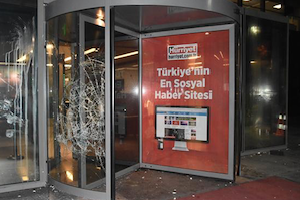
The recent spate of violent protests by Turkish ultranationalists – including attempted lynchings of ethnic Kurds -- and the attacks by government supporters on the Hürriyet newspaper have reinforced already serious concerns about both the deepening fissures in Turkish society and the continuing weakening of the rule of law in the country.
What the Columnists Say

Yavuz Baydar in Bugün writes that the assaults against media are part of the strategy of the AKP to ensure that the November 1 election yields a three-party parliament, without the HDP, with the AKP’s majority restored. Ömer Laçiner in Birikim warns that the election campaign threatens to be Turkey’s historically most violent one. Korkut Boratav on the sendika.org site writes that there is no reason to expect that finance capital is going to precipitate the fall of AKP from power by deserting Turkey. Ertuğrul Özkök in Hürrriyet observes that the new Chief of the General Staff Hulusi Akar made very unusual, ethnic references, to a supposed Turkish identity of the state of Turkey, in his Victory Day speech. Ali Bulaç in Zaman writes that Turkey’s participation in the Western war against IS amounts to waging war against Muslims, that this has no Islamic legitimacy, besides being politically and militarily wrong.
Baydar: silencing media to win the election
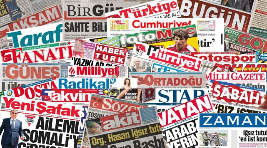
Yavuz Baydar in Bugün asks, what kind of game is it that is being played openly now with the suffocation of media? The preservation of power depends on the emergence of a three-party parliament at the polls on November 1. An equation of four parties will spell disaster. Thus, it is absolutely necessary on the hand that the HDP is left out of the parliament, and on the other hand, that MHP is undermined and its votes transferred to AKP. In order to achieve these goals, a never before seen manipulation of public opinion is called for. The “silent majority” in Turkey – the lower and middle classes – (at a rate of around 80 percent) follow only the TV channels as sources of information. And note that the efforts of the government to cut the media down to size have always been concentrated on the media groups that have TV channels. Of course, the turn will come to independent newspapers like Cumhuriyet, Taraf, Sözcü and Birgün as well after this. If their attempts to suffocate the media results in a backlash, if the distribution of votes among the parties do not change, the option to postpone these elections is kept as a card in the cupboard.
Visit also




Joint Center Publications
Op-ed Halil Karaveli "The Rise and Rise of the Turkish Right", The New York Times, April 8, 2019
Analysis Halil Karaveli "The Myth of Erdogan's Power", Foreign Policy, August 29, 2018
Analysis Svante E. Cornell, A Road to Understanding in Syria? The U.S. and Turkey, The American Interest, June 2018
Op-ed Halil Karaveli "Erdogan Wins Reelection", Foreign Affairs, June 25, 2018
Article Halil Karaveli "Will the Kurdish Question Secure Erdogan's Re-election?", Turkey Analyst, June 18, 2018
Research Article Svante E. Cornell "Erbakan, Kisakürek, and the Mainstreaming of Extremism in Turkey", Current Trends in Islamist Ideology, June 2018
Analysis Svante E. Cornell "The U.S. and Turkey: Past the Point of No Return?", The American Interest, February 1, 2018
Op-ed Svante E. Cornell "Erdogan's Turkey: the Role of a Little Known Islamic Poet", Breaking Defense, January 2, 2018
Research Article Halil Karaveli "Turkey's Authoritarian Legacy", Cairo Review of Global Affairs, January 2, 2018