With the Strait of Hormuz Blocked, Turkey Eyes Quicker Completion of the Development Road
By Emil Avdaliani
The Development Road – a 1200 km long project stretching from Turkey to the Persian Gulf via Iraq – could see renewed momentum for its realization. The blockade of the Strait of Hormuz compels Baghdad to look north for sea access via Turkey. For Turkey, the Development Road offers economic benefit, leverage over European supply chains and deeper influence in Iraq. The Hormuz crisis has strengthened Ankara's argument that overland corridors through Turkey are not optional but strategically necessary.

BACKGROUND:
The Development Road is a road-and-rail corridor stretching from Iraq’s southern ports near Basra northward to Turkey and then onto the European market. The project is estimated to cost around $17 billion and seeks to turn Iraq into a regional transit hub. Its core geopolitical purpose is to transform Iraq from a state heavily relying on oil exports and plagued by internal instability into a logistics bridge between Asia, the Gulf and Europe.
This is not the first time that the Development Road is being actively discussed. Iraq and Turkey have long expressed interest in the realization of the project. In Iraq, the ambition to position the country as a key transit artery originated in the Cold War era, but could not be realized during the turmoil of the last decades of Saddam Husein’s rule and the chaos that ensued the US invasion. But the Iraqi ambition also has deeper historical roots: the region served as a major transit route for ancient and medieval silk roads linking the Persian Gulf with the Mediterranean world.
Yet, what makes the present attempt to build the project more realistic is Turkey’s growing interest as a result of changed geopolitical circumstances. Turkey has been consistent in its support for the Development Road. One major factor that drives Ankara is the fear that it might be cut out from new routes of regional connectivity. The India-Middle East-Europe Economic Corridor (IMEC), which was proposed in September 2023 and is supported by the United States, Israel, the EU and key Middle Eastern countries explicitly bypassed Turkey.
To avoid being sidelined, Ankara announced the same year that it would double down on its efforts to develop the route through Iraq. Later in April 2024 a quadrilateral memorandum was inked between Iraq, Turkey, Qatar, and the United Arab Emirates during President Recep Tayyip Erdoğan’s visit to Iraq. That agreement provided the project a regional framework and brought Gulf capital into a corridor that had previously been exclusively Iraqi-Turkish.
Another factor benefiting the realization of the project is the Middle Eastern conflagration. With the Strait of Hormuz blocked and the Red Sea route under increasing threat, the chances of a successful implementation of the IMEC project are limited. The Iran war and the blockade of the Strait of Hormuz have deepened Turkey’s interest in accelerating the project and strengthened its argument that overland corridors through Turkey are not optional but strategically necessary.
Ankara wants to position itself as the northern outlet of Gulf trade and a central node between the Middle East and Europe. For Turkey, the Development Road offers economic benefit, leverage over European supply chains and deeper influence in Iraq. The economic rewards promise to be substantial: it is believed that the Development Road will add $55 billion over the next decade to the Turkish economy and create up to 70,000 jobs per year.
For Iraq too, this could be a golden political opportunity. Baghdad has long argued that the Development Road can diversify the economy, generate jobs and reduce reliance on hydrocarbons. The Hormuz crisis makes that argument more convincing to external partners. Europe sees the corridor as part of a broader strategy to reduce dependence on maritime supply routes. Meanwhile, the UAE and Qatar both now have stronger incentives to invest in overland logistics, dry ports and customs infrastructure. The fact that Qatar and the UAE joined the Development Road framework in 2024, well before the Hormuz crisis, is evidence that Gulf states were alert to the need to diversify their export routes.
IMPLICATIONS:
The disruption of the shipping through the Strait of Hormuz has had a significant effect on global shipping, particularly on the Middle East-Asia trade in oil and gas. Even if and when the Hormuz blockade is lifted, many Asian countries will be compelled to shift their oil and gas supply chains. While the Development Road would not fully replace Hormuz, especially not for crude oil and LNG flows, the project could see a boost to its development as a complementary overland corridor.
For Turkey the Development Road offers an opportunity to elevate its position as a central player in the Middle Eastern connectivity. The project would allow Ankara to incresase its engagement with the Persian and Gulf and eventually also beyond, to the Indian Ocean. This fits into the Turkish ambition of developing close relations with the wealthy Arab monarchies and to reconfigure the region’s trade routes so that they enhanceTurkey’s geopolitical clout.
In 2025 Iraq activated the TIR international transit system with pilot operations between Turkey’s Mersin and Iraq’s Umm Qasr Port. This is significant because it addresses one of the corridor’s core weaknesses: customs, paperwork, and border delays. Iraqi authorities also expanded the operation of the Al-Faw port which is scheduled to reach 3.5 million containers by 2028. This matters for Turkey because without Faw functioning as a major Gulf gateway, the Development Road’s impact will be limited.
Turkey’s Development Road ambitions also fit into a wider context of Turkish geostrategic expansion. In the South Caucasus, Ankara and Yerevan are pushing ahead with their stated goal to open up their long-closed common border and renew direct trade ties. Meanwhile Turkey strives to expand the Middle Corridor through Georgia, Azerbaijan to Central Asia. In Syria and Jordan, Ankara aspires to re-open the Hijaz railway linking the Anatolian heartland with the Arabian peninsula. In a northern direction Turkey serves as a primary commercial route for Russia for its trade with the Mediterranean world and parts of the African continent.
Yet, the Development Road is vulnerable to the disruption of maritime access to the Gulf as that inevitably will hamper trade with Asia. Iraq’s Grand Faw Port can only become a Europe-bound gateway if ships can safely enter the northern Gulf. A full blockade of Hormuz would therefore severely reduce Iraq’s links with the Indian Ocean. So, while the blockade of the Strait of Hormuz increases the strategic demand for an alternative such as the Development Road, it also undermines the project’s commercial potential.
At the same time, higher oil prices could increase Iraq’s fiscal revenues, offering Baghdad more room to fund infrastructure. On the other hand, insurance costs, energy-price volatility and anxiety among investors will raise the cost of capital. Construction materials, machinery and imported equipment risks becoming more expensive or delayed. If the Iran conflict escalates, international contractors may hesitate to work in southern Iraq, especially near Basra. The project already faces governance, security and coordination challenges, and the Hormuz crisis, should it continue indefinitely, will magnify all of them.
The security dimension is likewise important. The Development Road must pass through a country where armed groups, factional politics and external influence remain prevalent. The Hormuz blockade puts Iraq in a geopolitically delicate position. Tehran potentially could hinder the operation of a corridor that would limit Iran’s connectivity role in the region.
CONCLUSION:
The geopolitical situation in the Middle East has created favorable conditions for the Iraqi-Turkish Development Road. The India-Middle East-Europe Economic Corridor (IMEC) that the United States, Israel, the EU and key Middle Eastern countries favor has little chance of being realized any time soon. Meanwhile, the closure of the Strait of Hormuz has further elevated the role the Development Road could play.
The Iraqi - Turkish alternative is burdened by its own share of challenges, and the Hormuz blockade won’t necessarily accelerate the realization of the Development Road. Iraq remains plagued by instability, internal divisions and is vulnerable to Iranian meddling.
Yet, Turkey’s growing interest and commitment to the project, along with the pressing need to chart new routes of connectivity, can boost it. In any case, the Hormuz crisis has strengthened Ankara’s argument that overland corridors through Turkey are not optional but strategically necessary.
AUTHOR'S BIO:
Emil Avdaliani is a research fellow at the Turan Research Center and a professor of international relations at the European University in Tbilisi, Georgia. His research focuses on the hitory of silk roads and the interests of great powers in the Middle East and the Caucasus.
Gürcan: The prospects of IS in Turkey
Metin Gürcan in t24 writes the ISIS needs Turkey. ISIS has not yet declared Turkey a war zone. While ISIS is steadily losing ground in Syria and Iraq, Turkey is a centre for it in terms of logistics and finance. I see that the Turkey strategy of ISIS has four different levels: First, it aims to create a division between on the one hand Sunnis who become more Salafist and others, by carrying out acts of violence that increase the already significant tension along the sectarian, ethnic and political fault lines in Turkey. Second, it seeks to ensure that Turkey does not become an active member of the global anti-ISIS coalition by attacking foreigners in Turkey. Third, it seeks to radicalize the Islamist youth in Turkey that has become increasingly alienated from the traditional Islamic structures. Fourth, it will encourage the ideologically radicalized to take radical action, exporting the extremist Salafist groups that it has raised in the Turkish pool abroad. In fact, we can see that ISIS is very good at following the evolution of political Islam in Turkey, in recognizing that it can steal a role in the wake of the power struggle between the AKP and the Gülen fraternity, and as a result of the fact that traditional Turkish Islamism has fared so badly in its encounter with capitalism: this is something that increases the popularity of jihadist Salafist movements among increasingly alienated young Islamists in Turkey.
The PKK and the PYD: Comrades in Arms, Rivals in Politics?

By Gareth H. Jenkins
April 20, 2016
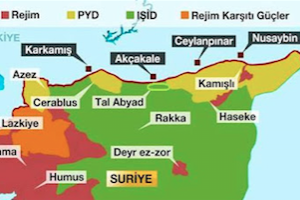
Although the Kurdistan Workers’ Party (PKK) and the Democratic Union Party (PYD) are ideologically affiliated, they remain organizationally distinct. Even though it does not pose a direct security threat to Turkey, the PYD’s increasing consolidation of power in northern Syria arguably poses a challenge not only to Ankara but also to the PKK.
Mahçupyan: ISIS and PKK both need to keep Turkey by their sides
Etyen Mahçupyan in Karar writes that it is obvious that ISIS has an understanding of Islam that leads it to see Turkey as an enemy, and that it intends to incite such an Islamic understanding inside Turkey. But at the same time, it is also clear that ISIS does not want to wholly be at odds with Turkey. Ultimately, it wants to be accepted as a force to bargain with in Syria and Iraq. Thus, even though they don’t hinder uncontrolled acts and though they may even resort to using violence as part of a strategy of “warning,” they have to get along with Turkey, insofar as they want to be a permanent force to reckon with in the region. The PKK’s position is no different. It’s easy to declare cantons (in Syria) when a war is raging, but much more difficult to sustain these when peace arrives… It’s obvious that you cannot categorically trust the U.S., Russia or Germany. In other words, when we pass on to the next stage in Syria, Turkey’s view of an eventual Kurdish entity is going to be a crucial factor… And what is at least as critical as this factor is the fact that the PKK runs the risk of alienating its sociological base in Turkey if it escalates the violence. In short, the two terror groups that Turkey is facing are in fact in need of Turkey’s “acceptance…” We can predict that both organizations are going to want to resort to violence in order to bring Turkey to the point that they desire, but that they at the end of the day are going to want to keep Turkey by their sides. As a new table is being set in Syria, the number of groups that would like to have violence in Turkey is thus decreasing, not increasing.
Bayramoğlu: Turkey should reconsider its approach to the Kurds
Ali Bayramoğlu in Yeni Şafak writes that the geopolitical winds are behind PKK-PYD and against Turkey. Turkey does not have any card up its sleeve that it can deploy to stop the Kurdish region in Syria that it sees as an existential threat. As long as this balance persists across the border, it is not reasonable to expect that Kandil (the headquarters of PKK in northern Iraq) is going to abandon its attempts to establish areas of sovereignty, its strategy of creating cantons, by means of urban warfare and the politics of ditches. The statements of the authorities promising that “soon the cleaning will be finished, and public order will be established,” appear naïve considering past events and the present balances of power. This is so even though a significant part of the population in the region does not approve of the actions of the PKK. This does not mean that they have edged closer to the approach of the state and its position. Isn’t it time that Turkey revises its reading of the region, its view of the Kurdish movements, the Kurdish question and its roadmap for the future?
Visit also