Erdoğan and the Iran War: Authoritarianism Makes Turkey Vulnerable
By Halil Karaveli
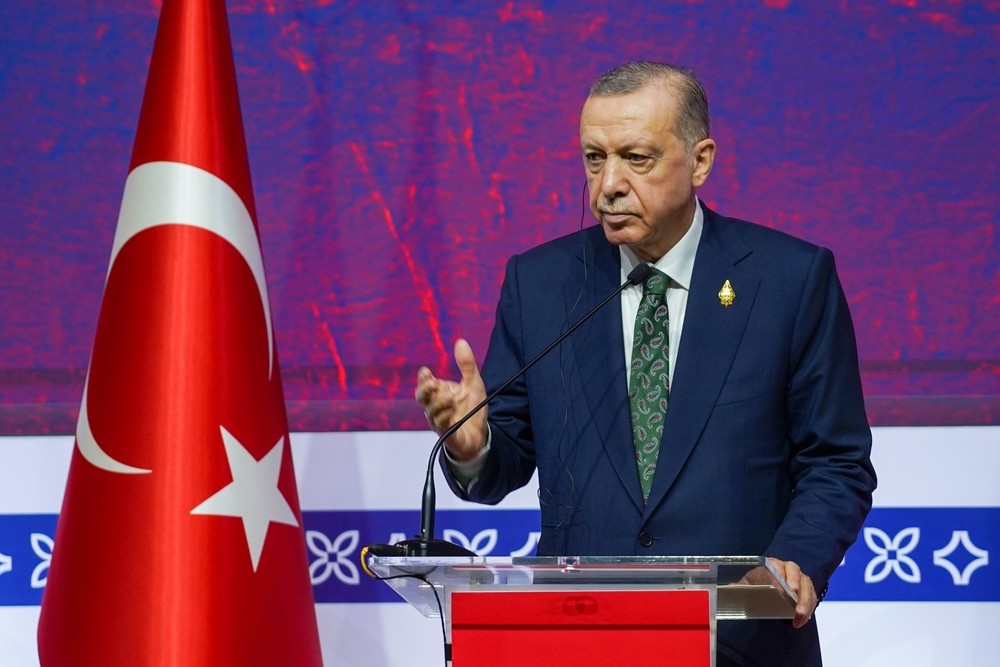
Provided that he succeeds in maintaining Turkish neutrality and in shielding Turkey from the fallout of the Iran war, President Recep Tayyip Erdoğan’s standing with the Turkish public will presumably be bolstered. But Erdoğan nonetheless faces difficult challenges and dilemmas ahead, as his personal power ambitions and national security imperatives ultimately cannot be reconciled. Having to contend with Israel’s regional domination and expansionism, Turkey is compelled to accommodate Kurdish aspirations, something that Erdoğan has so far been extremely reluctant to do. While Erdoğan’s foreign policy leadership may appear well suited for the perilous moment, his authoritarian rule isn’t.
BACKGROUND:
Speaking on March 14, Turkey’s Foreign Minister Hakan Fidan said that Turkey’s “primary objective” is to stay outside of the war in the Middle East. Fidan ruled out a military response at this stage in response to three Iranian missiles that were intercepted over Turkey by NATO defenses. Fidan said that available data shows that the missiles were fired from Iran, which Iranian officials have denied. “I know that we are being provoked and we will be provoked, but this is our objective,” he said. “We want to stay out of this war,” he emphasized.
In his statement on February 28, when the United States and Israel attacked Iran, assassinating its Supreme leader Ali Khamenei, members of his family and a score of government figures, Turkey’s President Recep Tayyip Erdoğan called for the return to diplomacy and a ceasefire to prevent the region from being dragged into a wider conflict. “We are deeply saddened and concerned by the U.S.-Israeli attack against Iran,” Erdoğan stated, eschewing outright condemnation. Claiming that the attack on Iran was the “result of Netanyahu’s provocations,” Erdoğan tacitly exonerated the U.S., singling out Israel as the main culprit. He also said that Turkey likewise finds Iran’s missile and drone attacks against the Gulf countries “unacceptable, regardless of the circumstances.”
Turkey and Iran are bound together by culture and ethnicity – Ali Khamenei was part Turkish, reciting poetry in Turkish, as is Iran’s President Masoud Pezeshkian – but separated by geopolitics. Since Antiquity, the powers that have controlled the Anatolian and Iranian plateaus – Greeks and Persians, Byzantines and Sasanids, Ottomans and Safavids -- have been locked in fierce rivalry over the control of trade routes and buffer zones from Mesopotamia to Caucasus. It’s no coincidence that Turkey and Iran have been on opposite sides in Syria and that Iran has supported Armenia against Azerbaijan. Geopolitics has trumped ethnicity and religion: the Ottoman and Safavid empires were both founded by Turkish tribes.
In their bid to challenge the Ottomans as the leading Islamic power and seeking to wrest Anatolia from it, the Safavids forcefully converted Sunni majority Persia to Shiite Islam – an unprecedented act in Islamic history -- which in turn prompted a turn to Sunni orthodoxy by the Ottomans. Yet while a weakened -- not destroyed -- Iran is in Turkey’s geopolitical interest, the hegemony that Israel is establishing in the Middle East risks cancelling out any potential Turkish gains.
Israel’s Prime Minister Benjamin Netanyahu recently declared his intention to forge a new “hexagon” of alliances designed to outflank an “emerging radical Sunni axis.” The regional counter-alliance that Netanyahu envisions would pointedly include Greece and the Greek-ruled part of Cyprus. Echoing the anti-Turkish statements of other leading Israeli politicians, former Israeli Prime Minister and opposition politician Naftali Bennett claimed that Turkey is a threat to Israel, and accused it of forming a regional axis “similar to the Iranian one.”
IMPLICATIONS:
On March 17, Erdoğan in turn alleged that “Israel is led by a network that considers itself superior to others and is gradually dragging the region toward a disaster.” “We all know that the attacks targeting Gaza first then Yemen and Lebanon, and most recently Iran, are not solely motivated by security concerns,” Erdoğan opined. In a speech to the Turkish parliament in October 2024, Erdoğan asserted that the Jewish state harbored designs on Anatolia. Voicing similar concerns, Foreign Minister Fidan in a recent interview said that “they (the Israelis) are after not security, they are after more land.” “So long as they don’t give up this idea, there will always be a war in the Middle East,” Fidan contended.
Yet somewhat inconsistently, Fidan dismissed the suggestion that Turkey could be the next target for Israel, while adding that “as long as Netanyahu is there, Israel will always identify somebody as an enemy.” Downplaying the notion of an Israeli threat to Turkey, Fidan insisted that “if not Turkey, they would name some other country in the region.” It’s clear that Turkey seeks to avoid a confrontation with Israel, but Israel’s avowed determination to check Turkey inevitably puts the two countries on a collision course. Fidan acknowledged that the Iran war has provided Turkey with an increased incentive to step up its own production of weapons and air defenses. Yet Turkey’s main defense against Israel is not military, but societal.
Turkey’s leaders are haunted by the fear that Israel will exploit Turkey’s ethnic divisions, as statements by Israeli officials indeed attest to. In November 2024 Israeli Foreign Minister Gideon Saar described the Kurdish people as victims of Turkish and Iranian oppression and Israel’s “natural ally” and called for strengthening Israel’s ties with them. Cognizant of Israeli intentions, Erdoğan in his speech to the Turkish parliament in October 2024 emphasized the need to “fortify the home front” in the face of “Israeli aggression.” Co-opting the Kurds is a national security imperative for Turkey, and Kurdish reactions to the U.S.-Israeli war on Iran have vindicated Ankara’s reconciliation since 2024 with the Kurdistan Workers’ Party (PKK) and its imprisoned leader Abdullah Öcalan.
While the United States and Israel have sought to mobilize Kurdish support in Iran and among Kurdish groups in Iraq in an effort to break Iran apart and bring down the Islamic Republic, Tülay Hatimoğulları, the co-chair of the pro-Kurdish Democracy and Equality (DEM) Party, denounced the war as an act of imperialism. Duran Kalkan, a leading representative of the PKK – which has officially dissolved -- stated that the Kurds are not going to serve anyone else’s military or other interests. Kalkan also defended that a solution in Iran must be reached by the peoples of Iran themselves and preserve the integrity of the country.
After Iran came under the U.S.-Israeli attack, Devlet Bahçeli, the leader of the Nationalist Movement Party (MHP), who in October 2024 initiated the latest Turkish opening to the Kurds when he held out the prospect of Öcalan’s release, asked his critics “do you now understand our purpose, why we have invoked Turkish-Kurdish brotherhood?” Meanwhile, Turkey’s former Prime Minister and Foreign Minister Ahmet Davutoğlu, the leader of the conservative Future Party, warned that Israel could try to derail Turkey’s peace initiative with the Kurds by provoking ethnic violence in Turkey, a statement that mirrors the fear-mongering of Israeli right-wing politicians.
Turkey’s electorate will now more than ever be looking for national leadership that conveys strength, which puts the main opposition Republican People’s Party (CHP) at a disadvantage. The CHP is animated by an idealistic faith in the discarded liberal order and struggles to stay relevant in the shadow of the war. The regional conflagration has overshadowed the trial of Ekrem İmamoğlu, the imprisoned presidential candidate of the CHP that began on March 9. For a majority, Erdoğan personifies the national strength that Turkey relies on in an anarchic and illiberal world. According to a recent poll, conducted a few weeks before the outbreak of the Iran war, 58 percent said that they would vote for Erdoğan if there was a risk of war while 20 percent said they would elect Özel. Only a few percent said they would vote for İmamoğlu in times of war.
CONCLUSION:
Provided that he succeeds in maintaining Turkish neutrality and in shielding Turkey from the fallout of the Iran war, Erdoğan’s standing with the Turkish public will presumably be bolstered. But Erdoğan nonetheless faces difficult challenges and dilemmas ahead, as his personal power ambitions and national security imperatives ultimately cannot be reconciled.
Democracy must be restored if Turkey is to consolidate its home front. Having to contend with Israel’s regional domination and expansionism, Turkey is compelled to accommodate Kurdish aspirations, something that Erdoğan has so far been extremely reluctant to do. And societal reconciliation will elude Turkey if reforms for the Kurds are coupled with oppressive measures against the main opposition party.
While Erdoğan’s foreign policy leadership may appear well suited for the perilous moment, his authoritarian rule isn’t.
AUTHOR'S BIO:
Halil Karavel is a Senior Fellow with the Central Asia-Caucasus Institute & Silk Road Studies Program Joint Center and the Editor of the Turkey Analyst. He is the author of Why Turkey is Authoritarian: From Atatürk to Erdoğan (Pluto Press).
Trump Is Strengthening the Logic of Authoritarianism and Nationalism in Turkey
By Halil Karaveli
Read the full article in Foreign Policy here.
In an illiberal world, the Turkish opposition can no longer convince voters that democracy alone is a source of strength.
Much has been written about how U.S. President Donald Trump is pursuing an authoritarian agenda at home while embracing dictators abroad. But even this criticism does not fully capture the way he has reconfigured the global order to strengthen the logic of authoritarianism itself.
The results can be seen with regrettable clarity in Turkey, where President Recep Tayyip Erdogan is a leading beneficiary of Trump’s force-based international disorder. Erdogan has simultaneously denounced the United States and cozied up to Trump, all while personifying the national strength that Turkey relies on in an anarchic and illiberal world. Turkey’s opposition, meanwhile, is animated by an idealistic faith in the discarded liberal order and vows to abandon Erdogan’s nationalist foreign policy. Unless it reconsiders and doubles down on nationalism, Turkish voters will return to Erdogan.
Erdogan presents himself as the incarnation of Turkish aspirations for regional and global power. He has long advocated for a multipolar global order not dominated by great powers, saying, “The world is bigger than five”—a reference to the permanent members of the United Nations Security Council. In pursuit of this vision, Ankara has cultivated strong relations with Venezuelan President Nicólas Maduro. When Maduro was captured by U.S. forces in January, Erdogan’s chief advisor, Mehmet Ucum, stated, “There is no option other than power-based struggle against imperialist aggression.”
At the same time, Erdogan has also acted as an acquiescent Trump ally who is keen to cooperate with the United States when it serves his purposes. Thus, as his advisor condemned imperialist aggression, Erdogan himself abstained from expressing any criticism of the Maduro raid. After a conversation with Trump on Jan. 27, Erdogan said, “We will continue to develop the cooperation between the United States and Turkey,” adding, “It’s in our common interest that the relations progress in all areas.” Turkey accepted the invitation to join Trump’s Board of Peace, while most NATO allies declined.
The relationship that Erdogan enjoys with Trump provides Turkey with opportunities to promote its national interests in tandem with the United States. According to a recent survey by the European Council on Foreign Relations, only 11 percent of Turks see the United States as an ally with whom they share values, but 42 percent see it as a necessary partner, with whom Turkey must strategically cooperate.
This opportunistic approach helps Erdogan make Turkey into a significant geopolitical actor, capable of projecting military and economic power from the Middle East and the Balkans to Africa and Central Asia. Disparaged by critics as an expression of imperial delusion, the extension of Turkish influence is a source of national pride and an unquestionable asset for Erdogan in today’s uncertain world.
What’s more, changing international conditions have increasingly fused the case for projecting power internationally with Erdogan’s case for projecting power in domestic politics.
Continue reading the full article in Foreign Policy here.
AUTHOR'S BIO: Halil Karaveli is a senior fellow with the Central Asia-Caucasus Institute & Silk Road Studies Program Joint Center. He is the author of Why Turkey is Authoritarian: From Ataturk to Erdogan.
The Turkish Referendum that Was Not

by Halil Gürhanlı
April 28, 2017
There was, arguably, hardly any point in Turkey’s April 16 referendum. Despite all the hype within the “yes” and “no” camps, both of which considered it as the most important vote ever to be cast in the country’s history, the referendum was never going to yield any major change in practical terms regardless of its result. However, the regime needed a seal of approval, without which it would have been impossible to keep acting as if it has even minimal democratic legitimacy. The referendum also served to further polarize and consolidate the bipolar hegemony in Turkish politics around the figure of President Erdoğan.
Ticking Clocks: Erdoğan and Turkey’s Constitutional Referendum

By Gareth H. Jenkins
March 31, 2017
Whatever the outcome, the Turkish constitutional referendum on April 16 will not resolve the country’s chronic domestic instability, heal its deepening social divisions, revive its flagging economy or end its growing international isolation. But it will shape both the nature of the further turbulence to come and the duration of what is already the final stage of the Erdoğan era.
Turkey Today: A Democracy without Opposition

By Burak Bilgehan Özpek
February 28, 2017
The AKP regime has from the very beginning of its rule successfully deployed the tactic of defaming and delegitimizing opposition. But the tactic has ultimately been successful because those who have successively been targeted by the AKP – seculars, liberals, the left, Kurds – have also held each other’s demands or opposition to be illegitimate. Turkey’s democracy is thus crippled not only because the opposition has been defamed and even criminalized all along since the beginning of the AKP regime. It is the divisions in society that make authoritarianism possible.
Visit also