What the Columnists Say

President Recep Tayyip Erdoğan’s recent statement that Muslims were the ones who discovered the Americas have stimulated many commentators to draw parallels to Atatürk who claimed that Turks from Central Asia had founded all the significant civilizations in the world. Murat Belge writes that Atatürk’s “Sun-Language Theory” was no less “ridiculous” than the theory about “Muslims in America.” Fatih Yaşlı disagrees, saying that the early republic and Erdoğan’s new Turkey cannot be compared, as the latter embodies an ambition to install a religiously authoritarian system. Ahmet İnsel writes that one important reason why the AKP has been able to perpetuate its hegemony is the way many modern, secular “progressives” look at people from the lower classes, that they accuse them of selling their votes in return for social welfare benefits. Yüksel Taşkın challenges the claim of Kemalists and many leftists that the liberals were responsible for paving the way for the ascent of the AKP. He writes that Kemalists were chiefly responsible for this, while the trouble for liberals is that they find it difficult to discard the notion that history inexorably progresses toward a positive ending.
The Return of the Generals

By Halil Karaveli (vol. 7, no. 21 of the Turkey Analyst)
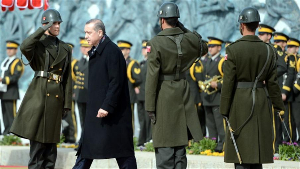
The Turkish generals are no longer afraid to speak out and they exert influence over government policies. Erdoğan invited the military back into the power equation when, faced with the Gülenist challenge to his power, and in need of a new ally, he gave the signal to open the prison doors for the convicted officers. But more than anything else, it is the persistence of an authoritarian mindset that sets the stage for the recurrent assertion of the power of the military in Turkey.
The AKP Uses the “Solution Process” to Suspend the Freedom of Expression

By Burak Bilgehan Özpek (vol. 7, no. 21 of the Turkey Analyst)
The strategies of the Turkish state to deal with the Kurdish question has undergone a dramatic change since the 1990s, but what has remained constant is the state’s stance toward freedom of expression. The ruling party of Turkey has repeatedly demonstrated that it uses lofty goals like democratization to severely restrict the freedom of expression and to suspend the rule of law. “Peace” is another such goal. The AKP’s strategy in the “solution process” with the Kurdish movement rests on keeping the process secret, and stigmatizing and intimidating those who raise questions. The AKP’s strategy indicates that “peace” can be just as viable as a strategy to secure and defend authoritarian power as armed conflict.
Planes, Palaces and Paranoia: Erdogan's New Turkey

By Gareth Jenkins (vol. 7, no. 20 of the Turkey Analyst)
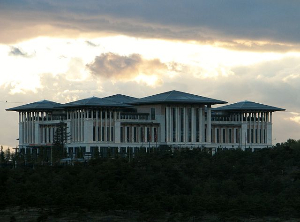
On November 4, 2014, Turkish Finance Minister Mehmet Şimşek revealed that a total of $800 million would be spent on a new palace and plane for President Recep Tayyip Erdoğan. The announcement has reinforced concerns about not only about Erdoğan’s increasing authoritarianism but also about his growing absorption into his self-image at the cost of the realities of the world around him.
The Failed Promise of AKP: The Bourgeois Revolution That Never Was

By Halil Karaveli (vol. 7, no. 19 of the Turkey Analyst)
Liberals expected the Justice and Development Party (AKP) to be a democratic reformist bourgeois party, because unlike its predecessors of the right, it was deemed to represent an “authentic bourgeoisie.” However, the liberals not only read too much into the AKP as a bourgeois party. They also invested too much hope in the “authenticity” of the said bourgeoisie. The case of Turkey stands as an example that bourgeoisie and state authoritarianism can be mutually reinforcing.
Visit also




Joint Center Publications
Op-ed Halil Karaveli "The Rise and Rise of the Turkish Right", The New York Times, April 8, 2019
Analysis Halil Karaveli "The Myth of Erdogan's Power", Foreign Policy, August 29, 2018
Analysis Svante E. Cornell, A Road to Understanding in Syria? The U.S. and Turkey, The American Interest, June 2018
Op-ed Halil Karaveli "Erdogan Wins Reelection", Foreign Affairs, June 25, 2018
Article Halil Karaveli "Will the Kurdish Question Secure Erdogan's Re-election?", Turkey Analyst, June 18, 2018
Research Article Svante E. Cornell "Erbakan, Kisakürek, and the Mainstreaming of Extremism in Turkey", Current Trends in Islamist Ideology, June 2018
Analysis Svante E. Cornell "The U.S. and Turkey: Past the Point of No Return?", The American Interest, February 1, 2018
Op-ed Svante E. Cornell "Erdogan's Turkey: the Role of a Little Known Islamic Poet", Breaking Defense, January 2, 2018
Research Article Halil Karaveli "Turkey's Authoritarian Legacy", Cairo Review of Global Affairs, January 2, 2018